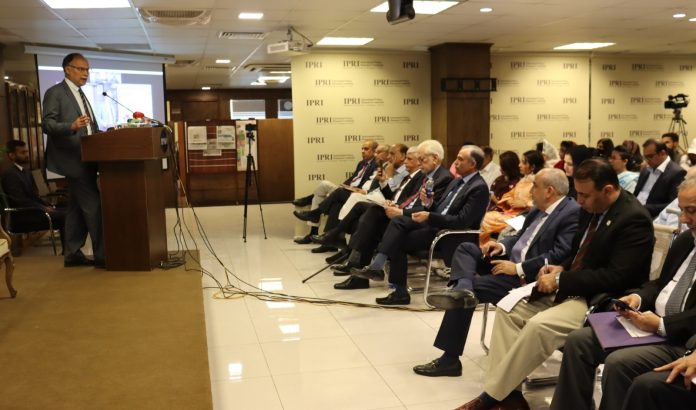
Minister for Planning, Development and Special Initiatives Professor Ahsan Iqbal said China would provide Pakistan with technical ‘know-how’ and expertise to increase exports and help successful execution of the Special Economic Zones (SEZs), under the CPEC project.
“We have requested China not to give us fish, [but] teach us how to catch the fish. Pakistan wants Chinese assistance to increase its exports and in successful execution of the SEZs. So China has promised to attach its experts [with quarters concerned in Pakistan],” he said while addressing an international seminar here.
The seminar titled “China-Pakistan Economic Corridor at Ten: A Gateway to Regional Connectivity,” was organized by Islamabad Policy Research Institute (IPRI).
IPRI President Ambassador Dr Raza Muhammad, Director Pakistan Institute of China Studies (PICS) Sargodha University Fazul ur Rehman, former SAPM on CPEC Affairs Khalid Mansoor, Director China Institute of Contemporary International Relations (CICIR) Dr Hu ShiSheng and Sohail Malik of Team Lead Climate Resourcing Coordination Center (CRC) among the leading speakers who spoke at a panel discussion of the seminar and highlighted significance of China-Pakistan relations besides various aspects of the game-changer CPEC project.
The panel discussion was moderated by Assistant Professor, Quaid-e-Azam University (QAU) Dr Salma Malik.
The minister said China had a vast experience in these sectors as it itself attained economic progress by increasing exports and establish vibrant industrial units besides having global chains for marketing its products.
Ahsan Iqbal said Pakistan needed export-oriented policies if wanted to have sustainable economic growth, stressing for clamping ‘export emergency’ to get exponential exports not incremental ones.
He also highlighted the importance to have surplus production of various items to increase the country’s exports as otherwise it could cause ‘local market distortion.”
“Next phase of the CPEC is business-to-business cooperation, not the government-to-government. Now we have to move towards industrial cooperation”, he added.
Elaborating, the minister said first phase of the China-Pakistan Economic Corridor (CPEC) project, initiated in 2013, was the infrastructure development by 2022, the second phase was industrialization from 2020 to 2025 and the third one was regional integration from 2025-30.
He said the incumbent government had revived the CPEC project, which faced slow-pace during the four years of the PTI government, expressing confidence it would be game changer not only for Pakistan but the whole region.
Now, he said Gulf countries were showing keen interest to invest in diverse fields of Pakistan including agriculture, mining, information technology and energy, for which a Special Investment Facilitation Council had been set up.
The minister said the country needed at least 10-year policy consistency to get the fruits of any development project.
He mentioned the CPEC projects in detail which helped in producing energy by different means, establishing a vibrant road and rail infrastructure across the country, special economic zones and laying of fiber optic cable for high-speed broadband services in remote areas and social welfare projects especially in Gwadar, an ultimate destination of the CPEC.
The minister said the CPEC had emerged as one of Pakistan’s most successful and transformative projects, ushering in a new era of regional connectivity and economic prosperity.