
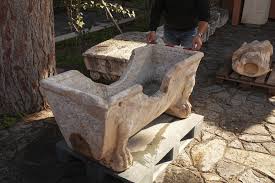
Archaeologists working at the ancient city of Ephesus in Türkiye’s Aegean region have uncovered a Roman-era marble bathtub and a fragmented male statue that had been reused as a paving stone.
The discoveries were made during ongoing excavation and restoration work at the UNESCO World Heritage site under the Culture and Tourism Ministry’s “Heritage for the Future: Endless Ephesus” project, which aims to open new visitor routes and bring previously buried artifacts to light.
The marble bathtub was uncovered along Stadium Street and is believed to have belonged to the Terrace Houses, once home to wealthy Roman families. Carved from regional Greco Scritto marble, the tub measures 1.46 meters (4.8 feet) long, 0.73 meters (2.4 ft) wide and 0.6 meters (2 ft) high.
Serdar Aybek, an archaeologist at Dokuz Eylul University and the project coordinator, said the bathtub dates to the first century AD, highlighting the importance of bathing culture in antiquity.
During the Roman period, large public bath complexes were common, Aybek said, citing the Harbor Baths in Ephesus as one of the most significant examples.
“Covering nearly 70,000 square meters, it is one of the largest structures in the Roman world,” he said. “However, these are public buildings that served large crowds. In addition, there were smaller bathtubs intended for domestic use.”
“The bathtub we found is one of those,” Aybek said. “It is an unusual discovery because it is not something we encounter frequently. We believe it belonged to the Terrace Houses and was used in the first century A.D. We found it during work at the theater, and its size shows it was used in a house.”
Aybek said the craftsmanship suggests the bathtub belonged to a high-income household and noted it was later reused during repairs in the city’s late period.
Archaeologists determined that the tub had been repurposed as a fountain trough, with holes cut to allow water to flow in from above and out from below, altering its original structure.
Another major find from Stadium Street was a male statue carved in multiple pieces, with the head, arms and feet produced separately and attached later.
Based on stylistic features, the statue dates to between the first century BC and the first century AD, Aybek said. It measures 1.23 meters (4 ft) high and 0.5 meters (1.6 ft) wide.
The statue was found face down after having been reused as a paving stone in the roadway.
- Torrential Rains Continue in KP, Trigger Flash Flooding Across Several Cities
- Sarsabz Unveils ‘Dil Se Dekho Sarsabz Pakistan’ Campaign Ahead of Independence Day
- Saqlain Mushtaq Heights Residents Protest Delays, Call for Refund or Time-Bound Possession
- Health Ministry Partners with LUMS National AI Hub to Advance Maternal and Child Health
- BYD Pakistan Receives Its Largest-Ever Shipment of NEVs at Karachi Port For Customer Deliveries