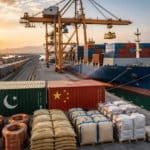

Key sectors of Pakistan’s exports including textiles, leather products, seafood, agricultural commodities, Sesame seed, rice, textiles, and garments have witnessed a significant surge in demand at china.
General Administration of Customs of China (GACC), the total value of exports from Pakistan to South China reached a record high of $973.21 million from January-December of 2023, compared to $836.645 million in the previous year. This upward trajectory is a testament to the resilience and competitiveness of Pakistan’s export sector.
Guangdong Province imported $379.011 million worth of goods from Pakistan in 2023, while Fujian Province imported $367.30 million On the other hand. Guangxi Zhuang Autonomous Region’s 86.790 million and $80.164 million, up by 8%, in 2022.
In 2023, Hainan Province imported goods worth $85.883 million, with a 56% increase, reported by China Economic Net (CEN).
The surge in exports to South China can be attributed to various factors, including the preferential trade agreement between Pakistan and China, known as the China-Pakistan Free Trade Agreement (CPFTA). This agreement has eliminated or significantly reduced tariffs on a wide range of goods, making Pakistani products more affordable and competitive in the Chinese market.
Due to the significant participation of Chinese participants in two major events held in Pakistan, the Food & Agriculture Exhibition and TEXPO 2023, Pakistan’s exports to South China surged by 69% in the second half of 2023.
Muhammad Irfan, Trade and Investment Counsellor Pakistan’s Consulate in Guangzhou, said that Pakistani textile manufacturers have managed to produce high-quality products at competitive prices.
Muhammad Irfan said that Pakistani government has also played a vital role in promoting exports to South China by providing various incentives and support to exporters. These include subsidized loans, export financing schemes, and trade exhibitions to showcase Pakistani products in the Chinese market. Furthermore, the geographical proximity of South China to Pakistan has facilitated the smooth flow of goods, reducing transportation costs and time.
This advantage has allowed Pakistani exporters to deliver their products more efficiently and gain a competitive edge over other countries.