
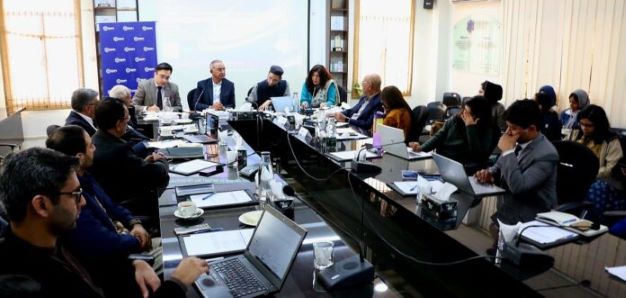
The experts at the public-private dialogue on information technology and telecommunication underscored that the country’s vision to boost its IT exports to significant level would be unachievable without resilient internet, as alternative connectivity options based on modern technology and terrestrial routes are the way forward.
Pakistan ranked a dismal 100th out of 111 nations for mobile internet speed and 141st out of 158 for broadband in a recent OKLA Internet Speed Test report.
Dr. Abid Qaiyum Suleri, Executive Director of SDPI called for a comprehensive strategy to regulate internet technology without disrupting connectivity. “We must learn from countries like China, UAE, and Saudi Arabia, which balance security risks with seamless internet access,” he said.
Jahanzeb Rahim, Member (Telecom), Ministry of Information Technology and Telecommunication while chairing the panel highlighted the critical dependence of Pakistan’s telecom sector on submarine cables and emphasized the need for diversification of terrestrial links to ensure robust connectivity.
Rahim proposed the adoption of orbital satellites as a complementary measure to enhance connectivity. He stressed the importance of collaboration between industry, policymakers, and academia to achieve sustainable growth. “The Sustainable Development Policy Institute (SDPI) can play a pivotal role by leading a charter of business practices that remain independent of political changes,” he suggested.
The Telecom Operators Association shared significant progress in fiber optic deployment, reporting the installation of 23,000 km of fiber optic cables and connecting four million households last year. Despite this achievement, Rahim pointed out that Pakistan’s 120,000 km optical fiber cable manufacturing capacity remains underutilized. “We need to scale up this capacity to meet future demands,” he urged.
Pakistan has also acquired a web trust audit for its key public sector infrastructure, becoming one of the few among 137 countries to do so. Rahim underscored this achievement as a step towards ensuring quality and secure services for end-users. “Our vision is to provide quality service to end-users, and with a market size of 20-22 million households, we aim to connect 10 million households next year,” he added.
Rahim highlighted Pakistan’s strategic geographic position, describing it as “the cusp of the highest population center” and likened its potential to becoming “the next Suez Canal or digital corridor of the world.” He also emphasized the need to boost the telecom sector’s contribution to the national GDP, which currently stands at a mere 1%.
Parvez Iftikhar, an International ICT Consultant, highlighted the need for diversification through terrestrial links with China, Central Asia, and Afghanistan. He proposed enhancing satellite backups to mitigate disruptions, particularly in rural areas. He also outlined Pakistan’s over-reliance on undersea cables, all landing in Karachi, as a key vulnerability. Any disruption—whether from natural disasters or sabotage—could disconnect the entire nation, he added.
Gull Zeba, CEO of RedMarker Systems, cautioned that the government’s ambition to boost IT exports from $2 billion to $25 billion would remain a pipe dream without resilient internet. “A single day of internet disruption costs end-users and businesses dearly. Without stability, investor confidence is eroded,” she remarked.
Chaudhry Mudassar Naveed, CEO of the Universal Service Fund (USF), highlighted the urgent need to enhance Pakistan’s internet resilience. He outlined five key factors impacting connectivity, focusing on infrastructure modernization, strategic links, and regulatory updates.
Naveed emphasized that submarine cables, a primary source of connectivity, are highly vulnerable, with rehabilitation efforts often time-consuming. To mitigate this, he proposed exploring terrestrial links through Afghanistan, Central Asia, or China, despite potential latency issues. He also stressed the importance of satellite backup systems, particularly for rural and remote areas.
Aslam Hayat, Senior Policy Fellow LIRNEasia shed light on the challenges impacting Pakistan’s internet resilience, citing both climate-induced and man-made disruptions. “Unusual climate patterns, including heavy rains, floods, earthquakes, and smog, are causing frequent internet outages,” Hayat explained.
- AGTL Delivers Strong Turnaround as Revenue and Profitability Surge
- National Savings Pakistan Raises Profit Rates on Multiple Schemes – 2026
- OxfordAQA and Karachi Grammar School Bring Educators and Counsellors Together to Strengthen Student Wellbeing
- Ufone achieves global recognition at Dragons of Asia 2026
- PTCL’s social impact and inclusive development initiatives honored at Dragons of Asia 2026