
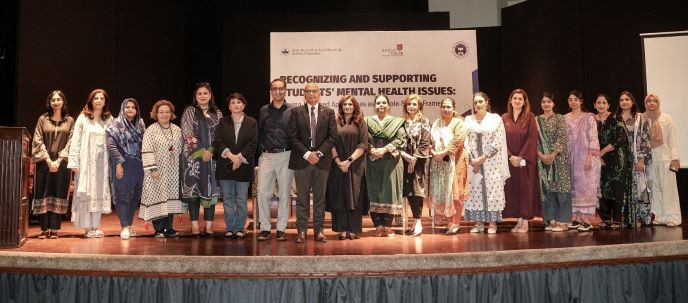
The LUMS Syed Ahsan Ali and Syed Maratib Ali School of Education (SOE), in collaboration with the Ali Institute of Education, hosted the seminar “Recognizing and Supporting Students’ Mental Health: Trauma-informed Approaches as a Whole-School Framework.” Held at the Ali Institute of Education, the event marked the culmination of a year-long project by the LUMS School of Education, in partnership with the Sanjan Nagar Public Education Trust (SNPET), to establish a whole-school trauma-informed system.
A key message throughout the seminar was that mental health is deeply interconnected with teaching and learning and must be recognised as an integral part of the relationships that underpin education.
Opening the discussion, Dr. Tayyaba Tamim, Dean, SOE, highlighted the hidden burdens many children carry: “Students carry invisible scars which they bring into the classroom,” she said.
Ms. Fizza Suhail, faculty member at SOE and subject lead for the project, outlined the case for a trauma-informed framework that serves every learner. “We need to have classrooms for students who are regulated and available to learn, but we also need the same classrooms to be there for students who are overwhelmed, dysregulated and unable to focus.” She further added that the framework is “inclusive of all students: both neurotypical and neurodivergent students, children facing adversity or those who live with a disability and also for children whose nervous systems are ready and primed to learn.”
Reflecting on the project’s work at Sanjan Nagar Public Education Trust, Ms. Beena Raza, Board Member, SNPET, spoke to the model’s wider potential, urging both private institutions and the government to take note: “If it can work in Sanjan Nagar, it can work in any other school.”
The panel discussion expanded on these themes, stressing that “mental health does not mean the absence of mental illness; in simple terms, it means to be able to flourish in school and beyond.” Panelists called on schools to move from a reactive to a proactive approach and emphasised the importance of teacher well-being alongside student well-being. They also noted that simply hiring counsellors is a limited, deficit-based response. Instead, meaningful change requires a whole-school approach that places relationships at the heart of education.
Building on its commitment to advancing education and understanding the diverse needs of learners, the LUMS School of Education is also launching its new BSc (Hons) in Educational Psychology this year. The programme brings together psychology, education, and human development, to equip students with the knowledge and skills to understand learners more holistically and support their development across diverse educational contexts. Its launch marks a new chapter for SOE, expanding its academic offerings while furthering its focus on creating more inclusive, responsive, and supportive learning environments.
The seminar brought together educators, researchers, government officials, and school leaders to examine how schools can better recognise and respond to the mental health needs of their students. The panel included Dr. Khurram Shahzad, CEO, Nawaz Sharif Center of Excellence Early Childhood Center; Ms. Sidra Jawwad, Head of Education, Cambridge Pakistan; Ms. Sara Faizan, Director, Ali Institute of Education; Ms. Beena Raza, Board Member, SNPET; and Ms. Fizza Suhail, faculty member at SOE, trauma therapist, and researcher.
- LUMS calls for trauma-informed approach to improve student well-being
- Al-Ghazi Tractors Champions Smarter Mechanization as Platinum Sponsor of Pakistan Agriculture Coalition’s Agri-Connections Conference & Expo 2026
- SECP Updates REIT Regulations to Make Real Estate Investment More Accessible
- PTML partners with myco to bring exclusive EPL discounts to Ufone and Telenor customers
- Climate stress puts Pakistan’s crops, rural economy and food security at risk